
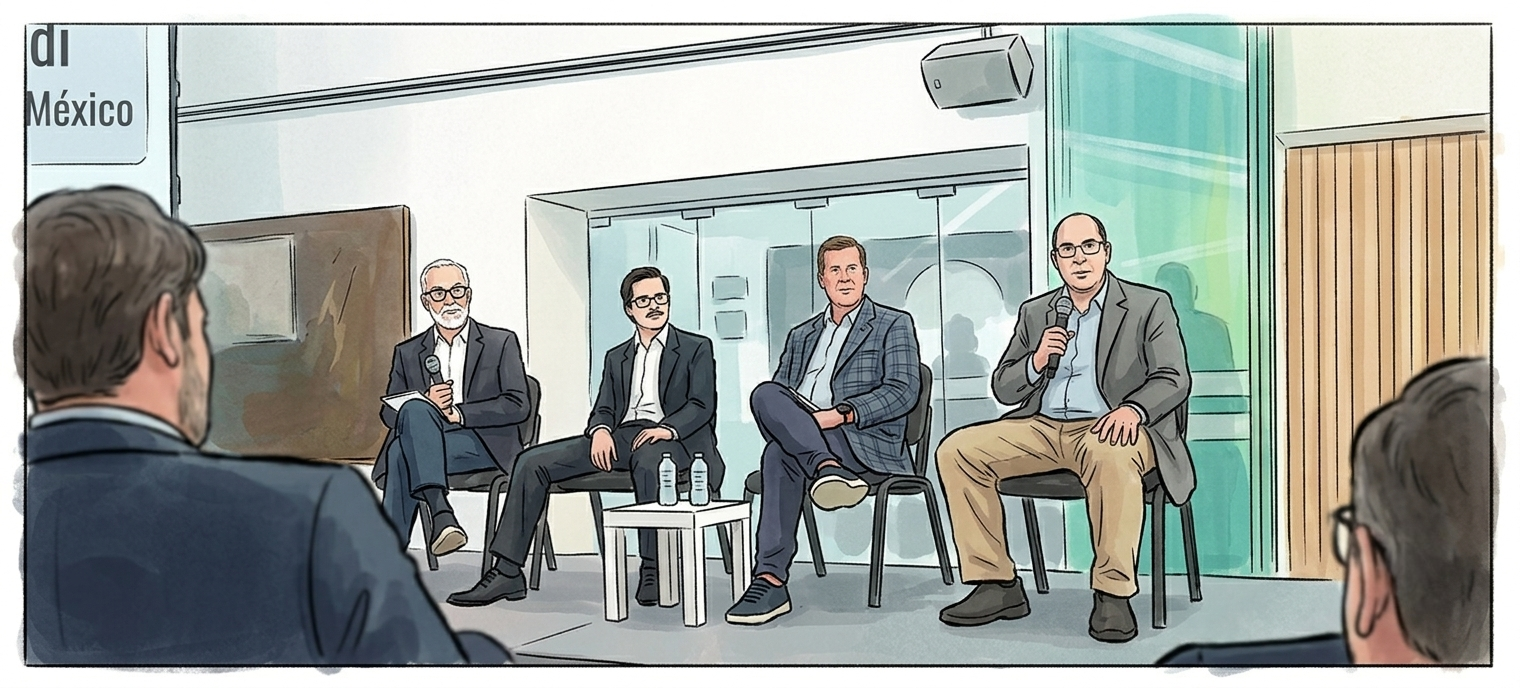
At the Unidad de Seminarios Dr. Ignacio Chávez — a conference venue set among the gardens of UNAM's Ciudad Universitaria, beside the university's botanical garden — roughly 100 university presidents and rectors from across Latin America gathered for the Universia National Meeting of Rectors, the higher-education summit convened by Banco Santander. Amid a program full of conversation about where artificial intelligence might one day take universities and higher education, Syracuse University was asked onto the stage to talk about something different: what is already working.
Paul LeBlanc — former longtime president of Southern New Hampshire University, Harvard visiting scholar, and author of the forthcoming Reclaiming Purpose: The University in an AI World (Wiley, 2026) — moderated a panel of Syracuse's Andrew Joncas, associate vice president for enterprise data and AI; Ron Stalnaker, chief business officer at Georgia Southern University; and Miguel Amigot, CTO of the AI engineering firm IBL.ai.
An agent named Clementine — for 22,000 students
Joncas described a project that had happened in a flash. "In the last about eight weeks, we deployed an agent to all 22,000 students at the university called Clementine," he told the room — the name a nod to Syracuse Orange. Students were told it would be available only 10 days in advance.
The problem Clementine was built to solve is one every leader in the room recognized. Each term, 22,000 Syracuse students have three to four weeks to choose from roughly 7,000 courses, often mapping not one path through the University but several. Built on IBL.ai's agentic platform, Clementine pulls together data from across the University and lets students ask questions in their own natural language in real time, at any hour, and, for the first time, in the language they speak at home.
"We didn't try to replace an advisor at all. We tried to take the advisement process from being transactional to strategic — allowing the student to have that conversation that matters with somebody that cares."
— Andrew Joncas, Syracuse University
That reframing matters most for first-generation students — the ones research shows are least likely to raise a hand and ask, wary of signaling that they haven't yet cracked the "hidden curriculum" of college. An agent that answers at 2 a.m., without judgment, becomes a quiet equalizer, and a tool for retention when students feel overwhelmed.
Right-sizing AI — down to 14 watts
With Mexican university budgets as strained as any, the conversation turned quickly to cost. Joncas argued that the era of cutting a single splashy deal with a major provider is over; the discipline now is matching the model to the problem. "I would love to drive a sports car every day to work," he said, "but I don't — I drive something more efficient, because I don't need it to get to work."
That thinking is pushing Syracuse toward small, task-specific language models — and, increasingly, onto the device itself. Working with Microsoft, the team has been developing models that run natively on Copilot+ PCs and Surface hardware, and says it has built one of the first apps to let a student learn with AI directly on their own machine.
"We've taken the cost related to electricity — from data centers, which are very expensive — down to 14 watts on a person's PC."
— Andrew Joncas, on on-device AI
For institutions serving students where connectivity and budgets are real constraints, Joncas framed on-device and open models as more than an efficiency play — they are a path to reaching students who would otherwise be left out.
Owning the code: the "SaaS apocalypse"
Perhaps the boldest idea discussed was about the software universities buy. As agentic coding tools mature, he argued, the old model — large teams and multi-year procurements for locked, subscription software — is being upended. Syracuse runs its IBL.ai platform inside its own infrastructure, keeping control of both its code and its data.
"We're all about AI sovereignty. You need to own your code, and you need to own your data."
— Miguel Amigot, CTO, IBL.ai
Stalnaker offered a concrete example that drew a reaction from the room: a single business analyst, using Claude, rebuilt Georgia Southern's entire campus portal — integrating its CRM and single sign-on across the university's core systems — in a weekend.
"A business analyst went home and in 48 hours rewrote the entire thing using Claude. And it's 40 times better."
— Ron Stalnaker, Georgia Southern University
The takeaway he pressed on the presidents was a strategic one: as software value shifts away from code itself, the questions for their CIOs and CTOs — about "code sovereignty," renewals and what to build versus buy — are about to reshape both cost structures and security posture.
Culture first, and leaders who go first
Asked to rank the hardest parts of an AI transformation — people and culture, data architecture or rethinking workflows — every panelist gave the same answer: people. Syracuse's response, Joncas explained, has been relentless, plain-spoken education. Every month the University holds open sessions for between 300 and 500 faculty and staff, teaching what the team knows at that moment and taking hard questions in an open forum.
"Lack of understanding is the driver of disagreement. That open discourse leads to understanding and growth."
— Andrew Joncas
On security, Joncas made the case that treating caution as a reason to wait is its own risk — if attackers let AI act at machine speed while defenders insist on a human in every loop, "the war will be over before it is ever started." The shift, echoed across the panel, is from humans in the loop to humans on the loop: setting direction and judgment while the routine work runs on its own.
Ron Stalnaker grounded it all in dollars, describing how Georgia Southern used Willow.ai across more than 300 buildings to cut utility spend by 2% in a single year — about $2 million — the first decline in the university's history. "Our local utility provider called me and asked me if everything was okay," he said.
"Leaders being really effective say, 'I don't know either, and some of this does scare me. Let's learn together.'"
— Paul LeBlanc, panel moderator