
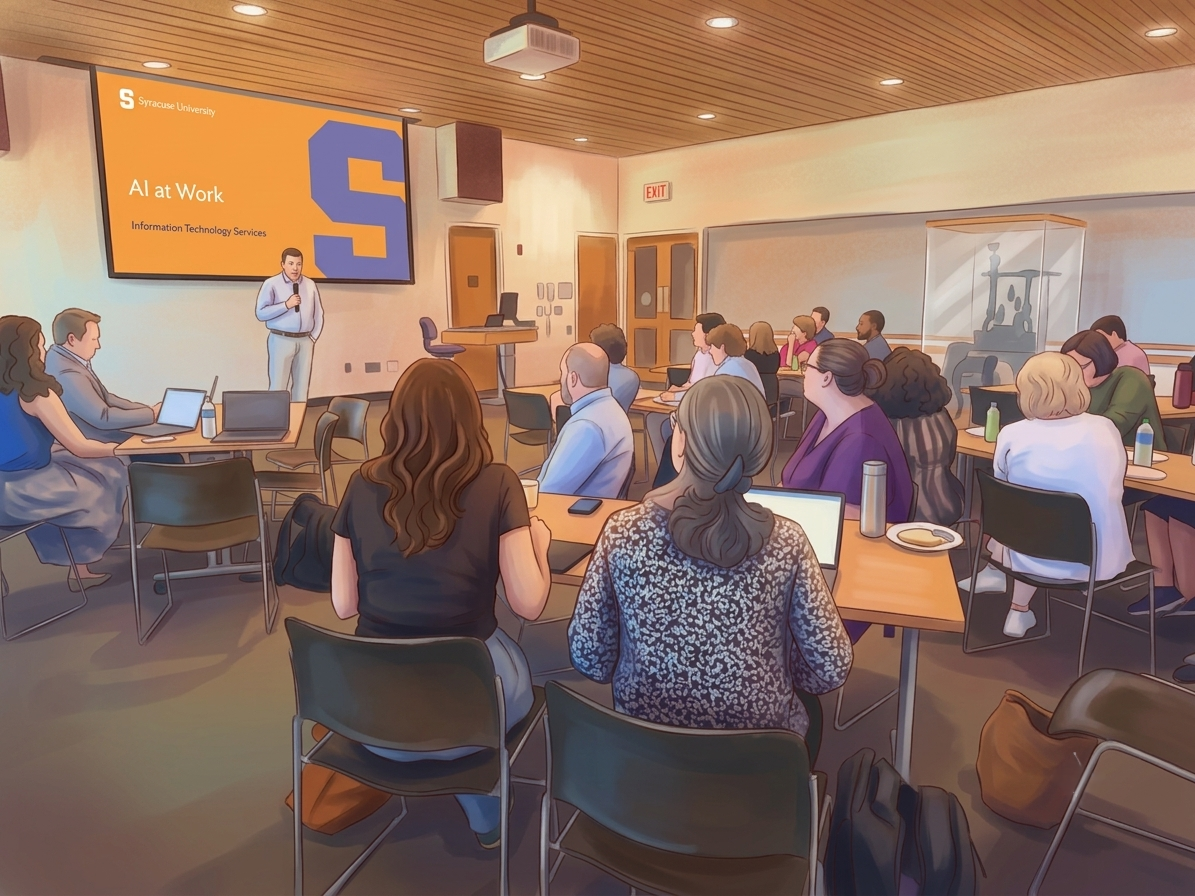
For more than a year, the Information Technology Services (ITS) department at Syracuse University has been making a steady case to its own campus about what already works with artificial intelligence — not in a white paper or a policy memo, but in rooms across campus, in front of its own faculty and staff.
That is the idea behind AI at Work, the recurring series run by ITS. Rather than promise what AI might do someday, each session hands the microphone to colleagues who show, in plain terms, what they are doing with it now. As Andrew Joncas, assistant vice president for data and AI, puts it, "It's the most equal opportunity technology I've seen yet."
Andrew Joncas and Ryan Elstad, senior director and architect on the Data and AI team, co-host the series live — in person and online at once — bantering back and forth as they level up the room's AI skills in real time, in a format audiences have dubbed part demo, part cooking show. And each session comes with its own recipe: demos and materials built fresh for that audience around a specific AI topic, with each series growing from beginner to advanced over time.
The rooms have filled to match. Over the past year, the series' hybrid sessions have drawn more than 1,800 people in person, with hundreds more joining each one online — and a single session topping 600 registrations. Adoption has kept pace: Claude usage at Syracuse University reached more than 10,000 activated licenses this spring, growing across students, faculty and staff alike.
What's already working: the Claude success stories
Several sessions have been given over to colleagues telling their own stories, framed by an idea from Jeff Rubin, senior vice president and chief digital officer: sort your job into three buckets — automation, the work you can hand off entirely; augmentation, where AI gets you most of the way and your judgment finishes the job; and agency, the human tasks that should stay human.
The automation bucket produced the series' sharpest before-and-after. Peter Skomsky, employee experience and quality assurance manager in Human Resources, had 11,000 files left over from a hurried move to remote work in 2020, none named consistently. Using a file-systems connector in Claude, he told it exactly how the names needed to read and let it work — roughly 8,000 cleaned up so far, with the broken cases set aside for a human to check.
"Nobody wants to sit there and rename 11,000 documents. We never would have done this without Claude."
— Peter Skomsky, employee experience and quality assurance manager, Human Resources
Augmentation stories ranged wider. Kim Infanti, executive director of alumni and constituent engagement, turned 300 pages of unread alumni-survey comments into a four-page executive summary "in 22 seconds." At Syracuse University Project Advance, assistant director Tavish Van Skoik cut the time to analyze years of course evaluations from 15 hours to three — surfacing a gap in instructor support he then moved to close.
What keeps these sessions honest is that presenters name where the tools fall short. Beth Myers, associate professor of inclusive education and executive director of the Taishoff Center for Inclusive Higher Education, described asking Claude for citations and getting one that listed her as the author of an article she had not written. It is a story she now tells her students about checking their sources.
"I use Claude as a partner, not as a replacement for my expertise — I bring the content knowledge."
— Beth Myers, associate professor of inclusive education
Where it started
The series did not begin with success stories. The first two sessions were a primer — what generative AI is, what it is not, and how to use it responsibly. One drew a bright line around what data belongs in an approved, university-contracted tool and what does not, and paired it with live demonstrations of the major tools and a plain-language framework for writing a good prompt: goal, context, expectations and, where useful, a source.
By the second session, the ground had shifted. The focus moved to a fast-moving landscape of more efficient and on-device models, to new agreements letting faculty and staff safely use additional tools, and to a piece of practical advice that still holds: stop asking which model is "best" and match the tool to the task. Early guest demonstrations — automating student scheduling, an interactive classroom role-play simulation — previewed the hands-on work to come.
Beyond the basics
As the community grew comfortable, some sessions went further — into extending and building with Claude. The Claude Skills session drew a clean distinction: a project is a reusable workspace for a recurring job, while a skill is a set of instructions that travels into every conversation, like a tool in a backpack. It built a few live, including a Syracuse University brand skill and a personal writing-style skill for the perennial complaint that "AI doesn't write like me." The Claude Code session, in turn, showed that building is not just for developers, walking through how someone with no coding background could stand up a working governance website in about a day — and closing with a broadly useful update: Claude add-ins now built into Word, Excel and PowerPoint.
Other sessions stepped back to ask harder questions. An ethics panel weighed not can we, but should we, landing on a blunt, practical rule: don't use the free version of these tools, because your data may be the price. A teaching and learning session sketched a Vision 2030 for the classroom — rethinking assignments so students show their thinking, and using the University's own data, carefully, to make each student feel individually known. And the recurring Claude on Campus walkthroughs turned a signup link into daily practice, making the case for Anthropic as a partner rather than a vendor as adoption climbed week over week.
What's next
The next AI at Work session is scheduled for Sept. 23. For anyone who has not yet requested a Claude license, sign-up and recordings of past sessions are available through the ITS AI resources.