
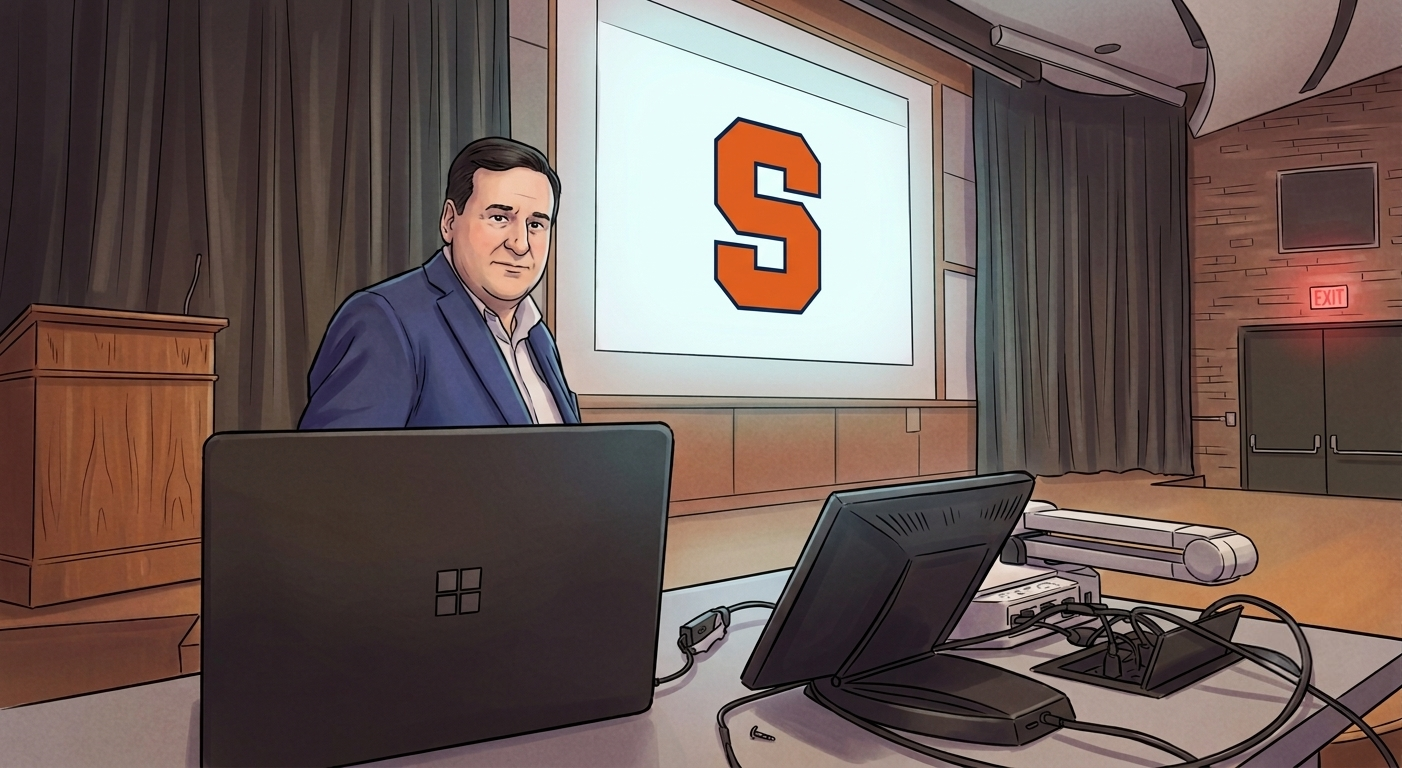
Behind Syracuse's most visible AI wins is a quieter, foundational effort. Working in partnership with Microsoft, the University's Enterprise Data and AI team has been building a unified data backbone on Microsoft Fabric — bringing campus data that used to live in silos into one place where it can actually be used.
One place for campus data
Operational, academic and student data at Syracuse had long lived in silos across dozens of systems and departments, making it hard to see what was actually happening across campus. The team's answer was Microsoft Fabric. Fabric brings data into a centralized analytics platform, creating a real-time pipeline of data that powers the university.
"When we started putting the pieces together, it became clear we needed an ecosystem that could bring everything into one place. Microsoft Fabric gives us a way to bring that data together and actually use it."
— Jeff Rubin, senior vice president and chief digital officer
Real-time intelligence, private by design
One example shows what that looks like in practice. Fabric Real-Time Intelligence is used to process the University's IoT and Wi-Fi sensor data into a clear picture of supply and demand, pushing occupancy accuracy from about 80% to 95% and unlocking more than 40 high-value insights — space-use gaps, cost-avoidance opportunities, shared-service bottlenecks and pain points in the student experience. Power BI turns that data into views that make spaces easier to find and give facilities teams a clearer picture of demand. And privacy is built in from the start: Microsoft Purview keeps those signals anonymous, preserving student privacy.
This smart-campus space and occupancy work — powered end-to-end by Fabric — is the same initiative Gartner named a 2025 Eye on Innovation finalist.
Part of a bigger Microsoft partnership
The data backbone is one piece of a broader Microsoft partnership. Surface devices with built-in neural processing units let Syracuse run AI at the edge; Microsoft Foundry and small language models synthesize student responses to in-class prompts so faculty can gauge understanding and adjust in real time; and Power Platform lets staff build tools without code — a Power Apps queuing system in the ITS MakerSpace has already handled more than 900 students. Intune, Windows Autopilot and Windows Hello secure and manage the fleet end-to-end.
"Surface allows us to run AI where learning happens — on the device itself. The future of AI is not everything going to the cloud; it's AI at the edge."
— Eric Sedore, associate vice president for information technology and chief technology officer
Built to scale, owned by Syracuse
To accelerate delivery, Syracuse partnered with PwC to move from ideas to implementation at scale — then took ownership. Knowledge and operation of the Fabric platform were transferred to Syracuse's own team, so the Enterprise Data and AI group can run it, extend it and onboard new data sources over time, with room to layer in emerging capabilities as the platform grows.
"Between Microsoft, PwC and Syracuse, we had a nice combination of technology and accelerator and ideas and challenges that we needed to solve."
— Eric Sedore, Syracuse University
Why it matters
A unified, governed, AI-ready data foundation is what makes everything else possible — from smarter space decisions to real-time classroom insight. It's the connective tissue beneath Syracuse's AI work, and the Enterprise Data and AI team is the group building and running it.
"For the first time in centuries, we have the ability to personalize learning. The challenge has always been scale."
— Jeff Rubin, Syracuse University
Learn more: Microsoft customer story: a connected campus with Surface and AI (opens in a new tab) · PwC case study on the AI-enabled campus (opens in a new tab) · Syracuse's Gartner Eye on Innovation recognition.