
When most people picture a data platform, they picture dashboards. Andrew Joncas would rather you picture a bus stop — and whether anyone is standing at it right now.
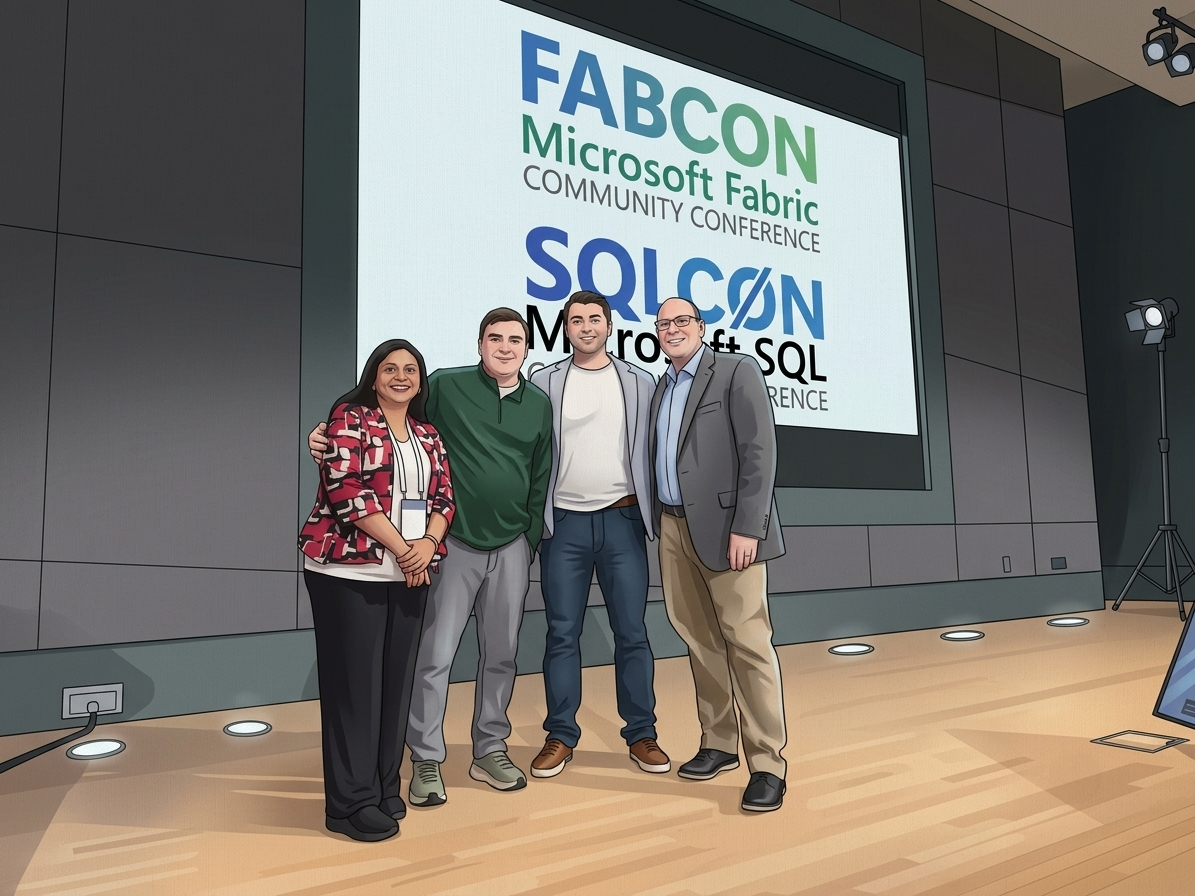
That was the through-line of "From Sensors to Insights: How Fabric Unified Our Real-Time Data," the talk Joncas, assistant vice president for enterprise data and AI, brought to the Microsoft Fabric Community Conference in Atlanta this spring. His argument was straightforward: a university can operate like a real-time enterprise, but only if it can see itself in real time first. The story of how Information Technology Services (ITS) got there is one of sensors, patience and a platform built to pull it all together.
A campus the size of a city
Syracuse University does not run like a single building. It runs like a small city — 22,000 students, 7,500 employees, a main campus in Central New York and seven academic centers reaching from Los Angeles and New York City to Florence, London, Madrid, Santiago and Strasbourg. Beyond the classroom, the University operates dining halls and restaurants, athletic facilities, stores, healthcare, finance, hotels, residence halls and even its own police and ambulance service.
A city that size raises city-sized questions. Is space being used effectively across classrooms, offices, conference rooms, athletic facilities and dining halls? Are students attending class? Are the dining halls meeting demand? Do rooms need cleaning? How full are the buses, and how busy are the bus stops? For years those questions had answers that were mostly educated guesses. ITS wanted evidence.
The single pane of glass you have to build
Answering them meant instrumenting the campus itself — buildings, buses and everything in between — and blending new infrastructure with what was already in place: IoT sensors, cameras, GPS, Wi-Fi and CBRS private wireless. The harder requirement was the platform underneath it. The team needed something that could process that data in real time and still support reporting, analytics and AI, all in one place.
"The only single pane of glass is the one you create."
That platform is Microsoft Fabric. Rather than wait for an off-the-shelf view of campus operations, ITS assembled its own. Working with partners PwC and JMA Wireless, the team stood up real-time operational intelligence drawn from edge AI vision models, thermal sensors and geospatial Wi-Fi data, unified in Fabric and turned into a live picture of how the campus actually moves.
From proof of concept to proof of scale
The pilot did not stay a pilot. Different sensor types and manufacturers turned out to be workable together, even with varying accuracy and timeliness, which let the team choose the best fit of price, precision and speed of deployment for each space. As results came in, the scope grew — and the proof of concept became a proof of scale.
One outcome from that expansion is the kind of result data teams hope for. A building under consideration for expansion was instrumented and measured, and the occupancy data showed the expansion would not be necessary. A capital decision that might once have rested on assumption rested instead on evidence.
The momentum has not slowed. Triangulated Wi-Fi data is now being folded in as another source, and the dataset is scaling to 97 buildings and roughly 4.2 million square feet. The work has drawn notice beyond campus, too: Syracuse University's real-time intelligence effort was recognized in Gartner's 2025 Eye on Innovation Awards.
Two stages in Atlanta
Syracuse University's story showed up twice at FabCon. In the executive track, Joncas joined a PwC-hosted client panel — "When Business and IT Build Together: Accelerating Trusted Data Products with Microsoft Fabric" — sharing the stage with data leaders from other enterprises to talk through what it takes to move from vision to real business value.
Then, on Friday morning, he co-presented "Sharing Experiences: Real-Time Intelligence — Customer Stories from the Frontlines of Fabric" alongside Tami Mahadevan of JetBlue. The session spotlighted how leading organizations are transforming operations and decision-making with Fabric's real-time intelligence — harnessing streaming data, event-driven architectures and AI-powered automation to reduce latency, cut operational costs and act in the moment. As the session framed it, these stories go beyond technology; they reveal the strategic shifts, cultural changes and measurable outcomes that define real-time success in the era of AI.
For a closer look at how that plays out across industries, Syracuse University also appears in a Microsoft customer panel on real-time intelligence, where leaders from higher education and beyond walk through their Fabric journeys.
The bigger picture
Fabric is one piece of a larger foundation. Syracuse University is building a scalable, secure and governed data and AI environment meant to support hyper-personalized teaching and learning, strengthen research and improve day-to-day operations — drawing on AI technologies from Microsoft, Anthropic and IBL.AI to get there.
The thread connecting a campus wired like a city to a stage in Atlanta is the same one that runs through all of it: raw signals only matter once they become decisions people can act on. At Syracuse University, they increasingly do.